Walking~and Loving~the Land (Favorite Photos #2)

Sitting on a bulbus rock above Arava Valley

Judy resting on a rock above Arava Valley

God said to Abraham, “Rise, and walk the land.” (Genesis 13:17)

What better way to become acquainted with the rocks, the dust, the fauna, the flora, the smells, the tastes, the changing colors than to stand in it, walk on it, be sheltered at night by it, rest your body upon it? To let your eyes gaze upon the painted vistas then search for trail signs and footholds to cross a river? To breathe the air upon chilly mountains, over silent deserts, and in redolent valleys?

John and Judy Pex did all this as middle-aged hikers who live in Israel—one as a descendant of Abraham and both as believers in the God of Abraham and his promised seed, Jesus the Messiah.

They walked where Jesus walked and “came away to a quiet place” as he did. They met various people groups who inhabit the land and for whose salvation Jesus gave his life. Judy kept a record of their trek over the 600-mile Israel Trail—what they saw, the people they met, and the insights they received. Then Cladach helped them share this experience with people around the earth through the book, Walk the Land : A Journey on Foot through Israel.

In a sense, a travel memoir is a gift to those who would love to go but probably never will. I enjoyed editing and designing this book and experiencing the varied land and people groups along the Israel Trail, vicariously. Here are a few of my favorite photos from Walk the Land by Judith Galblum Pex.

John walking the Carbolet

Nahal Raham, beginning to rain

Mt. Hermon from a ridge above Kiryat Shmona

John and Judy walked the entire Israel Trail from the Egyptian to the Lebanese borders!

Joy in the Journey ~ Favorite Photos #1

sage and deer at fence

Photo © Gayle M. Irwin

Are you experiencing joy, even when your path may lead through trials, disappointments, and losses? This kind of joy is infectious. With this joy you can “brighten the corner where you are.”

As a young teen in my father’s church I remember one old lady who stood in every testimony service to give an account of all her woes. Then in a mournful voice she would conclude, “But the joy of the Lord is my strength.”

Although my generation never thought we’d get old, the thought must have crossed my mind: “Is that what I have to look forward to, when I’m a ‘mature saint’?”

Since then I’ve met truly joyful elderly Christians who inspire me to focus on the gifts of each moment and on our abounding hopes for the future. Likewise, I’ve met Christians of all ages with disabilities who focus on their abilities and using with abandon the gifts they have (I had a wheelchair-bound friend who both painted and played basketball). I’ve met young mothers and fathers who have lost babies, or who face the fatality of serious cancers, but focus on unseen hopes, on loving and enjoying loved ones while they have life.

I’ve also witnessed this kind of God-created joy in nature. As children, my sister and I had a little dog named Buster who joyously followed our escapades in the neighborhood and in the vacant lot near the parsonage. Whether we were running, skipping, skating, riding bikes, walking on stilts … Buster was there. But trouble lurked in sticker patches where goatheads pierced his little paws. He never cried or stopped. Just kept running on three legs. More than once I saw him holding up a second paw and running on two legs! We hurried to his rescue and removed the thorn(s). But I do believe that, if he had stickers in three paws, he would have tried his best to hop along on one leg. It wouldn’t have surprised me—much—knowing Buster.

Nature—including our pets—can speak to us about the Creator’s ways and His provisions. We are drawn to nature photos for their calming, inspiring effect. These—and other types of photos—can add zing to blog posts and books. For instance, visual treasures—both of nature and other subjects—reside within many Cladach books.

In the next few weeks I’ll dig for these treasures and share my favorites here.

Today I present two black-and-white photos from Walking In Trust : Lessons Learned with my Blind Dog by Gayle M. Irwin (above and below). These photos show the joy of a dog named Sage as she experienced life and navigated her environment. Blindness didn’t stop her—or her people—from adventures (that you can read about in the book).

Who would think—from these photos—that Sage the Springer Spaniel was totally blind?

Sage inspires us to live fully, this moment, in the joy of the Lord.

Photo © Gayle M. Irwin

Colorado Book Award Finalist Teams Up With Mother on Sheep Book

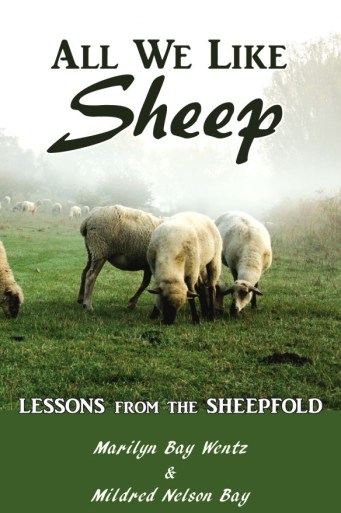
All We Like Sheep : Lessons from the Sheepfold  Produced with Team Effort

IMG_0644 - 2-Copy

GREELEY, COLO.—Colorado Book Award 2014 finalist Marilyn Bay Wentz, has teamed up with her mother, Mildred Nelson Bay, (both of Eaton, Colorado) to write a series of sheep stories and the lessons both women have learned from their collective seven decades of raising lambs commercially. All We Like Sheep: Lessons from the Sheepfold was released Sept. 15, 2015.

Wentz, a journalist whose first book, Prairie Grace (historical fiction set in 1864 Colorado Territory) was an award finalist, credits her mother as her mentor in both writing and sheep herding. Wentz says, “It was an amazing experience to write this book with my mother, considering her depth of knowledge, her love of both sheep and the Bible, and her gentle humor.”

All-We-Like-SheepAll We Like Sheep, a mix of creative memoir and Bible-centered devotional, was conceived from the heart and experience of this mother-daughter duo. “People see flocks of sheep grazing in the mountains or on the plains but understand little about the joys and trials of herding sheep,” says Bay. “Stories in All We Like Sheep: Lessons from the Sheepfold help the reader understand sleepless nights of lambing, attacks on the ewes by rogue dogs and coyotes, the bond experienced when the lambs respond to the shepherd’s voice, or how sheep protect themselves and ewes always recognize their own lambs.”

All We Like Sheep: Lessons from the Sheepfold closes the experiential gap between those who farm sheep, those who enjoy seeing pastoral scenes of sheep, and those who would like to better understand why the Bible so often mentions sheep (over 500 times).

These women are talented storytellers. Christian readers, especially, will appreciate the spiritual and biblical insights that Wentz and Bay have gleaned from their sheep-herding experiences. Each story/chapter closes with questions ‘to ponder’ and a short prayer. Photos from the sheep farm are sprinkled throughout the book.

Chapter titles include: “Ice Baby,” “A Lamb Called ‘Her’,” “The Little Ewe Who Thought She Could,” “Keep Out the Thief,” “It’s All About the Smell,” “Eternity in Our Hearts.”

Marilyn Bay Wentz grew up on the property her parents still farm northeast of Eaton, then lived in rural Strasburg for nearly two decades. She has written hundreds of news releases and articles for agricultural organizations and other clients. Mildred Nelson Bay and husband, Marvin, have farmed since 1970. She has been active in her local church, AWANA and Gideons, International, and has written articles for regional publications.

Click to learn more about All We Like Sheep, Lessons from the Sheepfold.


Afflict the Comfortable?

Bullet holes in the front door of the Alexander’s home in Taipei. Two members of the family were used as human shields and shot in police crossfire. Yet the Alexanders forgave their terrorist captor and helped lead him to faith in Christ before he faced execution for his crimes.

The famous newspaperman Joseph Pulitzer is said to have had this motto:

“Comfort the afflicted and afflict the comfortable.”

Do you think this is a good motto for a Christian writer? And maybe for a Christian reader?

Jesus gave comfort to the afflicted. He saw the real needs of individuals and responded in love and power. Today, the Lord works through his people to give comfort to those who are burdened, oppressed, and bereft; to build up others in love and faith to sustain them in the difficulties of life.

On the other hand, Jesus often unsettles us—afflicts us, if you will—with his words and actions. He criticized the religious and political establishments. He gave his time and attention to the weak, the sick, the unlovely, the powerless. He spoke directly to the heart.

Does the Lord want to use you as a writer to challenge and unsettle those who are insulated in ease? Perhaps the Lord wants to remind us of his call to feed the hungry, heal the sick, comfort those who mourn.

To be used this way, you may need to let him move you out of your “comfort zones” of shallow thinking, self-protection, and playing it safe. Read Jesus’ Sermon on the Mount. Read the Acts of the Apostles. Read about the lives and deaths of the early-church martyrs. Read about Christian persecution and martyrdom in the world today.

Other suggestions for reading that will “afflict” us out of our false comfort and into a life of more compassion and faith:

John and Judy Pex’s story of their work in Eilat, Israel. Reading about the Pex’s 30 years of personal evangelism in Israel can fortify you with the desire to live out the life of Jesus, perhaps even opening your home, your arms, or your prayers and giving to reach others with God’s love.

Stories of Christian refugees fleeing the genocide in south Sudan will disturb your ease but may also give you perspective on the troubles you face.

Reading about the Alexander family’s hostage experience at the hands of a Taiwanese terrorist may afflict you when you realize what evil there is in the world and what sufferings God allows his people to go through; or the Alexander’s story may comfort you to see how they were able to show love and salvation to the very man who caused them great bodily injury and emotional harm.

Now a word to readers: Open your hearts to what our Lord, who himself comforts the afflicted and afflicts the comfortable, may be saying to you. Don’t just read books that offer escape and make you feel good and even more comfortable. Read books that challenge you, maybe even afflict you with a desire to show compassion.

Boutique Publisher

Boutique

I received an email from someone who casually commented that Cladach is a “boutique publisher.” That struck me as a fitting descriptor of what we hope to offer to our authors, customers and readers.

What does the word “boutique” bring to your mind?

These words come to my mind: Unique, Hand-picked, Entrepreneurial, Personal, Artsy.

In my mind I picture many of the shops I’ve walked into while sightseeing and browsing in charming, coastal and mountain towns. These places offer something that WalMart, as predictable and cheap as it may be, can’t. As you step in the welcoming entrance, all the senses are soon pleased. You breathe the aroma of potpourri, and you’re enticed by complimentary samples of coffee, herbal tea, or truffles. Beautiful music plays unobtrusively in the background. Color, artfully arranged merchandise draws your eye and causes you to “oooh” and “ahhhhh.” You feel a sense of appreciation for the evident care that went into selecting the articles of clothing, gift items, handmade pottery, and other specialty items. You assume this boutique shop is an expression of the owner’s taste, and if you find their style appealing, you have a sense that you can trust their choices of items offered. You may think, “I’m glad I could experience this place! I want to take something home with me to remember my stop in this little town,” or perhaps, “I want to buy something to take back to my friend or family member, just to share a bit of this experience with them.” You may find the items offered so unique that you feel you must buy something, because you may regret it later when you are unable to find this particular, pleasing item again. The shop owner, who may even live upstairs, engages you in conversation. When you complete your purchase and walk back out onto the sidewalk with a custom-printed bag in tow, you have a smile on your face and a spring in your step.

Cladach is a boutique publisher in the sense that we want to offer an alternative to over-hyped, mass-produced, predictable books that cram the catalogs and warehouses of huge publishing conglomerates. We are picky and look for style that is artful, content that is meaningful and might give you an experience outside the box. We can offer ingenious, personal, one-of-a-kind books by authors both “down home” local and fascinatingly cosmopolitan. We can try new trends without being faddish. Quality matters to us and reflects our personal convictions. We hope our books give you an opportunity to step off the trafficky, noisy street and breathe deeply of heavenly scents; taste morsels of beauty, goodness, and truth; and find delightful, soul-lifting discoveries.

Are You Ready to Publish a Book?

hat-3

Acquisitions Editor Hat

Think that’s a glamorous hat? Think again. As a “boutique” (small, custom, picky) publisher, I wear this hat often, and at first glance it may seem to give power and appeal. Over time, though, it brings me to my knees.

With my acquisitions editor hat on I must make decisions to enter into contractual agreements with writers based on perceptions and best guesses. First impressions of an author or manuscript are subjective. I may like the person, writing, or idea based on personal preferences and interests or their persuasiveness and ability to engage me with their written expression.

If an author/book idea crosses that first threshold, it must then hold up under business scrutiny. Tough questions should be asked, analysis and forecasting applied. Is there enough demand for a book like this? If so, can we and the author reach the market for this book? Is it well written, engaging, and unique enough to compete with similar books? If it will catch the wind and begin to float, is the author ready and able to sail with it? Is this project financially feasible? Does it really fit in Cladach’s niche of literary waters?

If we answer too many questions “No” or “We don’t know,” and this process shoots too many holes in the potential project, it will sink before it starts with us. What we don’t want is to prepare a book, like a boat, to launch upon a sea of published books only to watch it sink. This has happened.

With some projects we know that we are testing the waters and risking storms at sea, but we believe in an author or project so much that we are willing take the risks. If we do that too often, though, we cannot stay in this business/ministry.

Some book projects we take on with excitement, but the sales peter out. Others catch wind in their sails and continue to sell week after week, month after month, year after year. With the benefit of hindsight I can see that the following factors make a difference:

  • What other titles has the author published? For instance, if his other titles are poorly-edited self-published books, this author’s reputation may suffer and hinder potential sales of the title we have carefully edited.
  • How actively connected is the author with the book’s prospective audience—even before she is published?
  • Is there a waiting audience/demand for this book?
  • Does the author have an ongoing means of reaching that audience? And is it an audience Cladach reasonably can reach out to?
  • Is the author’s personal life—including health, relationships, and finances—in order?

In my mind this begs the question: “As a writer, when are you ready to have your book published?”

Writers who feel they have something to say and long to be published authors, tend to become impatient. Your preparations to publish involve much more than finishing a manuscript and writing an effective book proposal. You need also to:

  • Find/identify/make connections with/get to know the audience for you and your book. (Start this ongoing process, in fact, even before you write the manuscript.)
  • Get your finances in order. It costs to publish and market effectively, even when you publish with a traditional, (large, small, or micro) royalty publisher.
  • Resolve, as far as you can, personal issues. Working as a published author takes time, energy, commitment, and the support of people around you.

As my mother used to say, “Work as if everything depends on you. Pray as if everything depends on God.” And that again brings me to my knees in the uncertain but enticing waters of acquiring book rights and taking publishing risks.

Janyne McConnaughey signs a Cladach book contract. This one was a good decision!

Evaluating the Past and Planning for the Future

Today I’m wearing my Analyzing/Forecasting hat.

hat-12

Larry has finished compiling last year’s book sales data from the careful records he keeps throughout the year. He lays before me a stack of neatly-columned reports. Now I take a deep breath, find my Financial Analysis hat, dust it off (most of the time I leave this side of the business to Larry) and sit down to focus on the telling numbers.

Each author will receive a statement (usually accompanied by a check) listing how many of their books sold last year, how many were returned, how many were given away as samples and review copies, the gross and net income we received for those sales, and the amount of author royalties for. I read through each line of these reports before they are sent to our authors.

In addition, Larry has print-outs for me of income, expenses, inventory, etc. I look these over, too, and bring my questions back to him. He patiently provides answers and makes adjustments where needed.

I’ll be glad to get back to the creative side of publishing. But I know that looking at these numbers and columns and net sums, is critical. Trends jump off the page at me and color my thinking about future decisions for Cladach.

First, I thank the Lord for the thousands of copies of Cladach books sold during the year. They sold through online retailers, wholesalers, events, bookstores, our website, and through the efforts of the authors. From our warehouse we send out varying quantities of paperback books almost every day. We love sending them out to reach buyers and readers, because that means they will minister to people, encourage them, instruct them, inspire them, help them see God at work in our world, help them experience Him more.

Then, I bring to the Lord our successes and our failures, and lay them at His feet. We have prayed over the acquisition, development, production, and marketing of each book. We are human, though, and make mistakes. Some of our titles have kept up regular demand and sales for years. A few have struggled to earn back the money we put into producing them. Most of the latter are excellent works by talented and sincere authors. Somehow, though, a few of those haven’t “grabbed readers.” We will keep trying, because we believe in these titles and these authors.

Next, I acknowledge the trends: For instance, with fiction titles, generally more e-books sell than paperback books. With all our titles, the more the author is active in marketing their books and connecting with readers, the more their books sell. Authors who have a “platform,” ministry, are well-known as an expert in their field, have several books published, and are active daily in some aspect of marketing their books — their books sell the most copies. This has to influence my decisions in acquiring future titles/authors.

It’s interesting to see how different books sell better through different sales channels. Some sell consistently through wholesalers, others simply don’t, but they sell well on Amazon. Some titles we mostly sell directly to the authors, who have ways of selling direct to customers. We give authors a generous discount, so they can actually make a lot more money on these sales than they can make with royalty income from Cladach’s sales. It’s a win-win, and most importantly, hope-giving books reach readers.

Perhaps I’ll share more trends in future posts. For now, I’ll hand the data/reports back to Larry and give attention to things I enjoy more: words, ideas, design, promotions, and the people behind the numbers. … I have a hat for that!

Running the Race ~ Writing for the Lord

A line-up of Cladach authors

Cladach’s Talented and Dedicated Authors

What makes a good author?

A good author is someone who has a burning desire to communicate through written expression, will pay the price to learn the craft of writing, will apply themselves to the process of writing, and will always keep their readers in mind. A good Christian writer loves the Lord, loves words, and loves people.

They can clearly answer the reporter’s questions:

Who: They know for Whom and to whom they are writing.

What: They have a clear focus and plan for what they are writing.

Where: They have a place to write and regularly “apply the seat of their pants to the seat of the chair” with pencil in hand or hands on keyboard.

When: They have a regular time to write and also have learned to snatch the moments and ideas as they come.

Why: They know why they are writing. A writer’s motives may vary: money (dream on), fame (rare and elusive), satisfaction, to scratch the itch (they can’t not write),…  Or, they relate to what the Olympic runner, Eric Liddell ‘s character said in Chariots of Fire: “God made me fast. And when I run, I feel His pleasure.”

If God has truly gifted these writers to write for Him, then their writings will give pleasure to readers also. From their writings readers will gain inspiration, courage, hope, understanding, insight, help.

These Christian writers have taken to heart Hebrews 12:1-2.

On hopeful paths of prayer and poetry,

~Catherine Lawton