Category: Answering the Call of Christ

Together With God

In this poetic essay I engage with the idea that we need to get involved—with others—in what God is doing in our world. Will we listen to what the past and present are saying, so we can move together WITH our loving God now … stepping into the possibilities that call us to a renewed future?


WITH

When the angel said to Mary, “For nothing is impossible with God”

and when Jesus said, speaking of the rich young man, “With God all things are possible”

did they mean that God would single-handedly make seemingly-impossible things happen?

Well, surely “with” means with. Possibilities are not actualities. But they can become so.

First, choices will be made . . . by God, by us. . . .

Choices matter in each

  • attraction or encounter.
  • touch or grasp.
  • reaction or response.
  • intersection or dead-end.
  • word spoken or thought silenced.

And, as in the case of Mary, life-giving choices and actions don’t happen alone but

WITH.

Whence comes this ability and necessity to choose, this invitation to respond and cooperate?

—From One who speaks potentiality, beauty, and creativity out of Love . . . connecting us as persons, relating us to all of nature, to every part of ourselves, and to God (through Christ who gives us life and the Spirit who is with us). We are image-bearers. We are all in some sense

WITH.

Living here in time and space, each of our moments is thick with the past—and pregnant with the future—calling us to be creators, curators, visionaries, encouragers, healers, leaders, servants.

Will we

receive the breath

heed the voice

cleave to the nearness

of God?

Will we give birth to actions of faith, hope, and love

WITH?

Look up—attend, listen to this present moment.

Look back—see the river of the past feeding into the now.

Look down—see that we are standing in an estuary of the potent, teeming present.

Look toward the horizon—see the future rolling and swelling. Which waves will break upon the shore?

Look around—all that surrounds us, that the river currents and ocean tides wash in, how it is mixing. At this time, in this place, what can we do to bring

  • clarity not murkiness?
  • free flow not stagnation?
  • sweetness not putridity?
  • abundance not scarcity?
  • hope that helps people know they are

WITH?

We are part of the becomingness of everlasting life!

Will we face the moment, listen to what it is saying about us, about the past that has influenced who we are, about what we are bringing into the future, and what the future may be bringing to us?

God—being revealed through Jesus, the Scriptures, and creation—is patient, persistent, longsuffering, even slow . . . convincing, helping, here

WITH.

Like compass needles, we seek, seek True North; and True North wants to, wills to, be found.

Yet, bent, we wobble and resist.

But God is not a faraway star. God is

  • the true atmosphere giving us breath.
  • the true magnetism holding us together.
  • the true dawn waking us again and again.

Does the needle think it is the true one and North should get in line?

God “strengthens the humble but opposes the proud.”—

This is to say, when we set ourselves in opposition, we cannot join hands

WITH.

No matter where we go, where we have been, where our feet stand now in time . . . we are not alone, never away from God’s influence, care, wooing. If “God with us” holds all our times past—keeps our “tears in a bottle”. . . . If God at every moment sees all the possible steps into the future. . . . If God imagines the myriad possible intersections of our path with the paths of others. . . . Then let us act, step out, take hold, clasp hands, join hearts

WITH.

Forces exist that would divide us, separate us, within, without.

God—Love—would bring us together.

In this estuary of the consequential, substantial present . . .

The young gambol in swirls of fresh water, thinking they’ll forever play among the land mammals, trees, and sun-drenched grasses.

We who have traveled longer sense saltiness in the water and feel the undertow pulling away from familiar moorings. We will soon find ourselves in the waters of what from here appears to be dark swelling mysteries and unfathomed depths … to a separation temporal, but a connection and communion everlasting.

Fresh water and salt water mingle here and now, but these waters continually recede, like breath and blood flowing in and out of lungs—rhythms of life attuned

WITH.

If we have a God who speaks, comforts, helps,

and in whom “all things hold together,”

then surely God is continually present to us and all creation?

And if God’s Spirit is manifest “wherever two or three are gathered,”

then surely God the Spirit is speaking and influencing here, there,

WITH.

In this moment, are we thriving?

How can we continue to stand, let alone flourish, if divided against ourselves—lacking harmony in our inner lives, our families, our churches, our nations, our world?

We say we believe some form of:

  • “God created the heavens and the earth.”
  • “God called creation ‘good’.”
  • “God so loved the world. . .”

Then God isn’t against us but

WITH!

Can we agree, in this in-between time of grace and faith, as we open our hearts and minds to the Alpha and Omega, to seek God’s reign and will “on earth as it is in heaven,” and work together

WITH?

This moment carries roots and leaves of past moments and seeds of all future moments. What we do—now—matters. Is this present mix of waters rich with life and health both ecological and societal? Jesus said we are “the salt of the earth” and “the light of the world.” We are caretakers of creation and each other when we partner

WITH.

Why do we blindly and stubbornly waste personal and corporate energies on greedy squabbles and turf wars?

Can we

  • accept slowness; unplug, listen, “fear not”?
  • trust together in creation’s innate ability to heal and renew, and accept our part in that?
  • acknowledge our own need for healing and renewal?
  • choose a mindset of benevolence for all?
  • have faith and hope in goodness and salvation?

Surely our God of creative, gracious, relentless love, will help us to join

WITH.

We need each other.

Will we lead the way by giving up worn-out stances, protectiveness, fear?

Let us be conservative—conservers of the truly good.

Let us be liberal—truly generous and tolerant.

We can each take responsibility to do something to make a positive difference, to be life-giving, to partner with God and each other in what Love seeks to do and calls us to participate in, as co-laborers. This labor is not burdensome, when we are yoked

WITH.

I know some people who choose to listen to, love freely, and work with God to sweeten the waters where they stand:

  • A prosperous, conservative Christian couple who cultivate acres of gardens to grow produce for their local food bank.
  • An evangelical pastor who has organized a ministry of prayer, friendship, and outreach to Muslim refugees in his city.
  • A retired professor and writer who follows God in vulnerability, revealing her trauma and healing to help others.
  • Contemplatives and poets who listen to and articulate a language of the heart to reach and touch fellow longing hearts.
  • Theologians reaching across institutional divides with hopeful understandings of God’s essence and presence.
  • A quiet man who invites neighbors into his home, where he and his wife pray and care for them, and share life together.
  • Wounded healers who listen, love, and pray with all who come; inviting, seeking, finding Jesus in broken places.
  • My friend who sits with people dying alone in hospital, so they will not die alone but know they are

WITH.

We stand here in a richness of the influential past and the potential future

as hope enlivens the waters. Will we:

  • vision together a more healthy and happy future?
  • seek healing for wounds we carry from the past?
  • affirm the good in this pregnant moment?
  • join hands together and partner

WITH God?

~Catherine Lawton


“With” (here slightly revised) was first published in the book Partnering with God. (SacraSage, 2021)

Unsplash Photos: 1) Joshua Gaunt 2) Nick Fewings


Courage!

“March on, my soul, with might!” (from “Deborah’s Song” – Judges 5:21b)

Sometimes I see a need but hesitate to step in and try to help. After all, who am I? Just little ol’ me. Sometimes I believe I have received a word from the Lord. But would others believe me or accept the word if I shared it?

Then I contemplate a favorite biblical heroine: Deborah (whose story is told in Judges 4 and 5). To me, she is an epitome of faith-filled courage. Deborah acted in ways unheard of (or at least highly unusual) for women in her time. She rose up and provided leadership when male leadership was fearful and hesitant. She had doubters and detractors, I’m sure. But she is immortalized and remembered for her devotion, wisdom, bravery, and leadership.

Deborah is the only female judge of Israel mentioned in the Old Testament. People would come to her for counsel and avail themselves of her wisdom and insights. Evidently, she knew how to listen for God’s “voice.” When she heard from God, she believed and acted with God to respond to a need.

Deborah confronted Barak, the general of the Israelite army, and told him God wanted him to go forth and defeat Sisera, leader of Jabin’s army. Barak, no doubt recognizing and admiring her ardor and courage,  answered that he would only fight if she would go with him. Deborah went … and inspired the Israelites to a mighty victory over their oppressors. And, as a musician and poet myself, I love that her rejoicing overflowed in song.

I admire women who let their experience with God embolden them to step into challenges, unfamiliar and perhaps hostile domains, and speak and lead courageously, effectively, and fruitfully. And I respect the men who listen to these women and “ride to battle” with them.

I wrote this poem (below) about Deborah. We can turn to Deborah for inspiration and strength to take courage and do what God is calling us to do, working with God in a way that flows out of our love for God and others.

DEBORAH

A fierce and beautiful woman
who inspired courage in men;
Sought out for wisdom and judgment;
trusted to lead and to win.

A woman who listened and let God
beat on the drum of her heart;
Marching to danger with faith,
speaking God’s words from the start.

Not full of self—neither loathing,
nor doubt nor concern—but aligned.
Giving and going and serving
in front of, beside, and behind.

Sure in times of uncertainty,
faithful when others despair;
Lifting the flagging to valor,
singing the victory aire.

~Catherine Lawton (from Remembering Softly: A Life in Poems)

Image: A 13th Century depiction of Deborah and Barak in the French National Library. Public Domain.


Are We In the Midst of A “New Reformation”?

“The fundamentalism of the last century is waning. And the liberalism of the last fifty years has failed to reform the Church.” –Adam Hamilton

If you don’t sense deep, unsettling change in our ways of doing church and being Christians in the world today, then I don’t know what planet you live on, or what church you attend (or have quit attending). I certainly have felt the winds of change, not only as a Christian writer/publisher, but as a church member and a person seeking to live on mission as a Jesus follower today.

My studies at Northwind Seminary (where I received my Masters Degree in Specialized Ministry) guided my thinking to gain a broader perspective on what many are calling “a New Reformation.” You’d be right if you said, “Didn’t we have a Great Reformation already?” But look back through history, and you will see that many times of renewal, revival, awakening, and reform have occurred during periods of upheaval in the world and a mix of self-satisfaction, apathy, and spiritual hunger among Christians.

If you want to be involved in what God is doing in the church and in the world, you pay attention, you listen to the winds of the Spirit; and you join hands, prayers, and efforts with other “listeners.”

In that spirit I want to share Northwind Seminary’s take* on the “New Reformation” we seem to be experiencing:

Ecclesia semper reformanda is a common Latin phrase used by church reformers to remind the people of God that “the church must always be about reforming.” The early Jesus Movement and Apostolic Church, the Imperial Church of the Holy Roman Empire, the Protestant Reformation, and Roman Catholic Counter Reformation, all had their day and role to play in the growth of the Christian tradition. At least three “Great Awakenings” in the history of American Christianity served to renew the Church at critical times. The “Great Emergence” of new church forms and fresh expressions of ecclesia at the turn of the third Millennium of Christianity served to prepare the way for a Global Church—no longer centered in Europe or America, but growing in the global south, Asia, and Africa. What next ‘new thing’ will the Spirit of God do in the world? What new ways and forms will characterize the next Church?

Behold, I am doing a new thing; do you not perceive it? –Isaiah 43:19

…Affirming a both/and approach, we affirm the great classical Creeds of the Christian tradition as well as the prophetic radical edge of what it means to follow Jesus today in a postmodern, post-Christian, traumatized world. As Richard Rohr reminds us: “The prophets of old were both radicals and traditionalists. With penetrating insight and wisdom, they saw into the heart of their own tradition and called the people of God to embrace a new day. We shouldn’t be surprised if we find ourselves falling in love with our tradition and wanting to radically change the way things are.”

…“I believe that Christianity is in need of a new reformation,” writes Adam Hamilton….“The fundamentalism of the last century is waning. And the liberalism of the last fifty years” has failed to reform the Church. “The new reformation will be led by people who are able to see the gray in a world of black and white.”

…”The new Reformation,” says theologian Elaine Heath, “is all about the emergence of a generous, hospitable, equitable form of Christian practice that heals the wounds of the world.”

According to Robert J. Duncan, founding president of Northwind Seminary, “The Church is moving from the modern to a postmodern world, fueled by digital media and innovative uses of new technology. We have an opportunity to redeem the technology of the global culture and use it for ministry in the digital age….Electronic circuit riding in the twenty-first century is the new form of evangelism and mission.”

Professor Leonard Sweet identifies an important parallel between the modern and the postmodern Reformations: “If the technology that fueled the Protestant Reformation was the printing press, and the product was ‘The Book,’ the technology that is fueling the Postmodern Reformation is the microprocessor and the product is ‘The Net.’

As a Christian futurist, Professor Sweet adds: “The NextChurch has two challenges: getting clear and clearing out.” Getting clear about who Jesus is and clearing out spiritual deformities that dis-order the church’s structural life and dis-able mission.” In the process, “the role of pastoral leadership is dramatically shifting from representative to participatory models” in the priesthood of believers.

…Professor Thomas Jay Oord sees a light at the end of the revolution. As we walk in God’s light we are becoming all that God has called us to be… as our ever-loving and relational God “guides us, inspires, nurtures, nudges, and coaxes us” into greater creativity and wholeness.

*The entire article, originally written and posted by Michael J. Christensen, can be found here: https://kairos.edu/2023/10/27/partnership-spotlight-northwind-theological-seminary/

and here: https://donkeysdelight.blogspot.com/2023/08/northwind-seminary-shares-its-mission.html

More about Northwind Seminary here: https://www.northwindseminary.org/

The beautiful photo by theologian/photographer Thomas Jay Oord is used with his generous permission.(I added the bolding of phrases.)

On hopeful paths of prayer and poetry,

~Catherine Lawton


Waves on the Cladach

What does “Cladach” mean? That’s a question we often hear. So let me explain:

CLADACH (Kla’ dak) is a Scottish Gaelic word meaning beach or shore, as in seashore.

“Early in the morning, Jesus stood on the shore.” ~ John 21:4

The Lord sends us forth on life’s sea to venture for him, all the time welcoming us to the safety of his shore; and always God is with us.

The Courage of Authenticity

It takes courage to be an author, to declare and publish to a busy, perhaps skeptical world what you have experienced privately … to tell in “bright lights” what you have seen and learned in dark places.

Long ago in Bethlehem, shepherds waiting and watching on a dark hillside experienced a wondrous awakening and illumination. Then, even as they stood there in awe of the heavenly hosts, the shepherds must have needed courage and bravery to leave their flocks in the care of their guard dogs and run into the dark, crowded city of Bethlehem to look for a newborn baby “in a manger” and then worship him as the promised king. Surely there were more qualified and famous individuals to use as messengers.

I think the needed courage gripped the shepherds because the authenticity of their experience and their certainty of it overcame their trepidation. They obeyed, they went, they told. And their story was full of immediacy and hope.

Sometimes we authors feel that way.

Though angels didn’t exactly appear to us in the night sky and declare wonderful tidings of great joy for us to write,  Christian writers do sense a call from God and we experience wonder and the help of God (and perhaps even of angels) as we write. We certainly have good tidings to share.

Janyne McConnaughey is an example of one writer who has a life-changing story of hope and is compelled to write and tell her story to encourage others. I don’t know whether she has been “touched by an angel” but I know she has been touched by God with the courage to share her story. The title of her first book, BRAVE, tells that. And these comments from readers and reviewers on Amazon.com tell us of the authenticity and immediacy and hope in her story.

  • “There is hope!”
  • “A compelling journey”
  • “A very important book”
  • “A road less traveled … a path to healing”
  • “Kept me on the edge of my seat”
  • “Powerful story”
  • “Healing from complex trauma”
  • “A roadmap to freedom”
  • Brave is a fitting title for this true story.”
  • “A beautiful soul shows us the way to hope and healing.”
  • “A book every person who has struggled with trauma should read.”
  • “This book can be your path to healing from childhood trauma.”

Whatever your place of waiting ‘in the night’—or journey in the dark— be encouraged. A savior is born and he brings good news to the oppressed, including those suffering from complex trauma.

~Catherine Lawton


Photo: Hubble Space Telescope

Don’t Settle for Dormancy—Live Abundantly

Are you settling in to dormancy?

In November I’m reminded of nature’s cycles of dormancy and productivity. Here in Colorado, many trees are losing their leaves. Grass will soon go dormant and turn brown.

Trees and shrubs have produced seed pods and cones; flower heads have released seeds that may sprout and surprise us in the garden next spring. Pumpkins have been cut open and seeds scooped out and roasted.

Author and field biologist Carol O’Casey unwraps the wonder of seeds—using science, literature, personal experience, and scripture—and applies this to the believer’s life of faith. In Unwrapping Wonder, she writes, “Often times, in order for us to blossom into the abundant life God has in store for us, we must accept our own spiritual brokenness—just as germination requires the seed coat to be broken.”

Don’t settle into dormancy and stay there.

“Are you lacking the life-giving water necessary to initiate the germination process? Do you long for an abundant, seed-coat-busting life? Abandon your dryness and lifeless routine. Risk heat. Risk exposure. Risk growth. And take heart. Jesus tells us, ‘Unless a kernel of wheat falls to the ground and dies, it remains only a single seed. But if it dies, it produces many seeds’ (John 12:24)”

Thank you for reminding us, Carol, that even during dormant seasons life is waiting in the seeds. Some plants will sprout surprisingly early, as soon as daylight hours start increasing. Meanwhile, wait in hope and expectancy.

As Carol says, “Allow God to unleash his power in your life. Be ready to sprout where you are planted. And live. Abundantly.”


Photo Credit: flickr

Finding the Sacred in Place, People, and Story

“Are you hungry for a life that is more than simple existence, for something to give you hope, for surprises bathed in an eternal aura? Do you long for fellow travelers, for genuine community, a place where you can tell your story and listen to others? With whom you can share life and experience mission?”

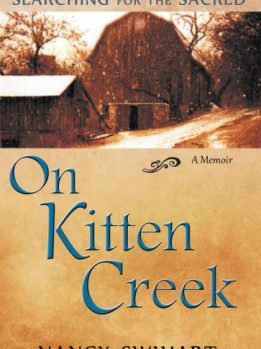
So begins the book ON KITTEN CREEK: Searching for the Sacred by Nancy Swihart

God seems to make sacred the places where true Christian fellowship and community happen.

Inspired by Francis and Edith Schaeffer’s L’Abri center in Switzerland, Nancy Swihart and her husband dreamed of starting something similar in America, where people could come to learn about and experience—away from their usual distractions—”the God who is there.”

When the Swiharts left their thriving ministries, that were full of “promise” in Southern California and moved to a rustic, old 160-acre farm in the Flint Hills of Kansas, a missional center developed that came to be known as “Wellspring.” This loosely formed, and constantly evolving and renewing fellowship of folks experienced true, transformational community. Through the past thirty years, thousands of people of all ages have benefited from what Wellspring has offered in sacramental, creative, loving, and edifying ways.

Nancy’s memoir released this week.to the following praise:

“Nancy Swihart’s On Kitten Creek is an uplifting and thoughtful read. It will minister to your spirit and move you to give thanks for life’s simple gifts and cause you to reflect deeply about your life, as it has prompted me.” –Ken Canfield PhD., Founder National Center for Fathering; President, National Association for Grandparenting

“Let Nancy give you glimpses of His handiwork among us. Be inspired to look for sacred connections and creative opportunities waiting to surprise you within what may seem mundane in your own life.” –Kay Bascom, Author, Teacher, Missionary, and Conference Speaker

“A look over-the-shoulder and through-the-heart of someone with much to teach every one of us.” –Steven Garber, Principal of the Washington Institute for Faith, Vocation & Culture; author of Visions of Vocation: Common Grace for the Common Good

I first met Nancy at the Colorado Christian Writers Conference. Drawn by her warm smile, I became convinced that her story fit every part of Cladach’s stated purpose to:

• exalt Christ as Savior and Lord, and know God as Creator, Father, and Redeemer-King.
• witness to His presence and work in creation, and in our world today.
• encourage believers in a mind-set and heart experience of joyful faith and obedience.
• provide practical guidance for developing a life of health and wholeness.
• through the power of story, depict grace to a postmodern world.

Nancy practices listening prayer, gives of herself in hospitality, has searched for and found the sacred in her daily life, and has embraced mystery in the mundane—while caring for farm animals, taking prayer walks on the farm trails, hosting ministry events in the barn, or teaching at a Christian college and giving hospitality to students. Active in local churches, schools, and wider ministries, the Swiharts and their friends together have dreamed, laughed, cried, celebrated, served and shared the life of Christ creatively in ways we all long for.

Let Nancy inspire you to embrace the story that God is writing in your own life!

Amazon currently has the price discounted from $13.49 to $8.83. It’s also available in Kindle and Nook.

Here’s a picture of the Wellspring barn (that is on the book cover) in more recent years undergoing a remodel:

 Nancy with two farm animals, including “Donk” who is in the book.

Nancy with friends at her book-signing in the barn yesterday.

A beautiful tower of books:

On Kitten Creek

(Thanks to Nancy Swihart and Terri Gasser for the photos.)

Susan Roberts Interview

[youtube https://www.youtube.com/watch?v=FVM_NFdV7Ag?rel=0&w=640&h=360%5D


Are you listening, in prayer, to what the Lord may be asking you to do? Are you watching for His answers? Susan Roberts describes how saying “Yes” to the Lord led her on an adventure of devotional discoveries. I interviewed Susan to find out why and how she wrote Everywhere I Look, God Is There.