Category: Offering HOPE

Finding the Sacred in Place, People, and Story

“Are you hungry for a life that is more than simple existence, for something to give you hope, for surprises bathed in an eternal aura? Do you long for fellow travelers, for genuine community, a place where you can tell your story and listen to others? With whom you can share life and experience mission?”

So begins the book ON KITTEN CREEK: Searching for the Sacred by Nancy Swihart

God seems to make sacred the places where true Christian fellowship and community happen.

Inspired by Francis and Edith Schaeffer’s L’Abri center in Switzerland, Nancy Swihart and her husband dreamed of starting something similar in America, where people could come to learn about and experience—away from their usual distractions—”the God who is there.”

When the Swiharts left their thriving ministries, that were full of “promise” in Southern California and moved to a rustic, old 160-acre farm in the Flint Hills of Kansas, a missional center developed that came to be known as “Wellspring.” This loosely formed, and constantly evolving and renewing fellowship of folks experienced true, transformational community. Through the past thirty years, thousands of people of all ages have benefited from what Wellspring has offered in sacramental, creative, loving, and edifying ways.
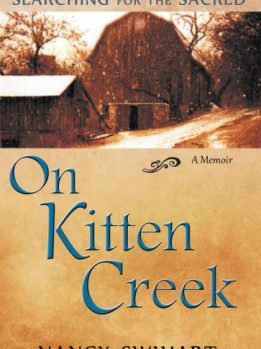
Nancy’s memoir released this week.to the following praise:

“Nancy Swihart’s On Kitten Creek is an uplifting and thoughtful read. It will minister to your spirit and move you to give thanks for life’s simple gifts and cause you to reflect deeply about your life, as it has prompted me.” –Ken Canfield PhD., Founder National Center for Fathering; President, National Association for Grandparenting

“Let Nancy give you glimpses of His handiwork among us. Be inspired to look for sacred connections and creative opportunities waiting to surprise you within what may seem mundane in your own life.” –Kay Bascom, Author, Teacher, Missionary, and Conference Speaker

“A look over-the-shoulder and through-the-heart of someone with much to teach every one of us.” –Steven Garber, Principal of the Washington Institute for Faith, Vocation & Culture; author of Visions of Vocation: Common Grace for the Common Good

I first met Nancy at the Colorado Christian Writers Conference. Drawn by her warm smile, I became convinced that her story fit every part of Cladach’s stated purpose to:

• exalt Christ as Savior and Lord, and know God as Creator, Father, and Redeemer-King.
• witness to His presence and work in creation, and in our world today.
• encourage believers in a mind-set and heart experience of joyful faith and obedience.
• provide practical guidance for developing a life of health and wholeness.
• through the power of story, depict grace to a postmodern world.

Nancy practices listening prayer, gives of herself in hospitality, has searched for and found the sacred in her daily life, and has embraced mystery in the mundane—while caring for farm animals, taking prayer walks on the farm trails, hosting ministry events in the barn, or teaching at a Christian college and giving hospitality to students. Active in local churches, schools, and wider ministries, the Swiharts and their friends together have dreamed, laughed, cried, celebrated, served and shared the life of Christ creatively in ways we all long for.

Let Nancy inspire you to embrace the story that God is writing in your own life!

Amazon currently has the price discounted from $13.49 to $8.83. It’s also available in Kindle and Nook.

Here’s a picture of the Wellspring barn (that is on the book cover) in more recent years undergoing a remodel:

 Nancy with two farm animals, including “Donk” who is in the book.

Nancy with friends at her book-signing in the barn yesterday.

A beautiful tower of books:

On Kitten Creek

(Thanks to Nancy Swihart and Terri Gasser for the photos.)

PRAISE! for Easter

Are you feeling pressed down by the negativity of the world—bad news, worries, hurts, fears, anger?

If you enjoy contemporary, spontaneous, free verse—or if you are willing to try poetry as a remedy for the affliction of a heavy spirit—Cladach has just released Mary Harwell Sayler‘s book, PRAISE! Poems.

Read this book during Holy Week and be ready on Easter to sing “Hallelujah!”

Let an explosion of praise break forth in your own life with adoration and celebration of our good God!

While these short, contemporary poems acknowledge the realities around us, they also look for the good in everything.

Sections within the book include: Praise • Prayers • Easter • Creation • Wonder • Christmas.

Here are a few sample poems from the book:

Quiet, Strong, and Positive Social Justice

 GUEST POST:

Think of the most polarizing social issues. Now think of your daily life, the people around you that you love, that you meet, that you pass at lunch on the street. If you didn’t watch the news and weren’t inundated by media, would you be full of animosity and vitriol towards any of them who hadn’t wronged you personally?

Your response to my question might rightfully be that people wouldn’t be aware of important issues and problems without so much media. Maybe. But I wonder whether media isn’t causing the problems to snowball and take on global lives of their own, instead of quietly and locally wasting away?

People might actually get along better as local individuals—and better recognize that perhaps they actually do get along pretty well with all kinds of people with all kinds of views—if they weren’t constantly hooked into the mind-feed. And I can guarantee that the issues wouldn’t be dominated by sound bites and catch-phrases promoting simple dichotomy of complex issues and crushing the possibility of honest dialogue.

And that’s where I should end the post; but I’m going to continue in a sort of wistful way to say that we can’t take away the press, even if it is often hired to promote special interests in their attacks of other interests. But we can take a break from the constant mind-feed and, instead, consider anew the real people around us, consider our own decisions and thoughts and actions and how we might do some good in the world.

Maybe that could be social justice. And maybe it would be quiet and strong and positive, acknowledging the imperfections—not only of the injustice-doers, but of the world generally, and especially ourselves. And there would still be crime, and there would still be poverty, and there would still be inequality, but maybe we could all be more loving, more content, more peaceful and thereby make our lives a little better and make the lives around us a little better.

–David Lawton


Photo Credit: Collage © Mark Fraley. Original Art from the book, Creation of Calm by Mark Fraley.

An Early Lesson in Racial Reconciliation

Corcoran-bday-1958

Children can feel the tensions, prejudices, and injustices that exist around them.

When my sister and I were about 6 and 7 Daddy pastored a church in a coastal town in Central California, where the parsonage was in a racially-mixed neighborhood. We thought nothing of the fact that we played with Black children. We went into each others’ homes and each others’ apron-clad mothers gave us drinks of water and fresh-baked cookies. I only remember feeling acceptance and friendliness.

Then we moved to a valley town where 2/3 of the student body in our elementary school were Black and Mexican-American, many the children of transient farm workers. In this school in the 1950s, I first experienced racial tension. There I first heard the “N” word used. We were naive little girls, unprepared for the sights of gangs fighting on the playing fields, busloads of kids shaking their fists and yelling out the windows. As insults and epithets flew, I thought, “What is this?!” At the age of 9 I didn’t know anything about the civil rights movement taking place in our country.

I do remember Daddy driving us to a farm workers camp and the shock and sadness I felt when I saw how some of my classmates lived. No sidewalks, no trees, no grass. Just dirt and squalid shacks that couldn’t really be called buildings. No indoor plumbing, out by the cotton fields, with no respite from the hot sun.

Some of our school mates bragged about how they didn’t have to go to school during the cotton harvest. They were going to pick cotton with their family and make lots of money! Bev and I went home and told our parents we wanted to pick cotton and make money and not have to go to school! Mother shook her head. “Girls, you don’t know what you’re talking about. It’s back-breaking work. The cotton plants cut your hands and make them bleed. And the farm workers get paid very little. Those children’s parents need the extra money their children make just to help them subsist.” I had a hard time believing my mother. When we drove by fields of ripe cotton, the bursting heads looked white puffs of softness.

We were learning about divides between people groups that couldn’t be crossed.

My second-grade sister had a more personal learning experience. She got into an argument with another little girl on the playground, probably over the rules of a four-square game or something. It just happened that the other girl was Black. As the girls hurled insults at each other, the worst thing my sister could think to say was, “You’re nothing but a big chocolate sundae.” Understandably, the girl took offense. She could have yelled back: “Well, you’re just plain vanilla ice cream.” Instead she hit my sister, who then sat on the ground crying. I got scared and ran home (we lived across the street from the school) to tell our parents Bev was hurt. Daddy came to the school, found that only Bev’s pride was wounded, and made her apologize to the girl.

Well, that was really hard for Bev to do. But later, she and the little girl became friends. When Bev had her 8th birthday party, she invited this girl. The picture above (with the church building in the background) shows the two of them with me (age 9) in the middle.

If only reconciliation were always that simple.

Or maybe it is that simple!:
Wise and caring authority figures, don’t hide from suffering. Help us face the truth about ourselves and each other, encourage asking for and receiving forgiveness, then give us opportunities to celebrate our common humanity. 

Better than Destruction and Despising

san-francisco-85652_1920

I’m starting a series of guest posts from authors. Today we hear from John Buzzard, whose first book, Storm Tossed, is a war memoir (of more than one kind of warfare).

As John shows here, we humans have a tendency to embrace “us and them” attitudes. We point fingers and condemn, when Jesus says to love and pray. Especially in these days of polarizing politics and issues, even Christians can find themselves in the position of using our energies protecting “our group” while, in essence, wishing that God would destroy the “other group.” John tells about a time he found himself in such a situation:


by John Buzzard:

I moved to Alameda, California, and got a job with a security company guarding the former Naval Air Station. Going from a police officer to a security guard was humbling, but I took it on faith God had something better in mind for me. My wife and the kids and I moved into a small, expensive apartment and started attending a local church.

I drove a white pickup truck around the base from 10 p.m. to 6 a.m. When I got tired I’d park on the tarmac, pour myself a cup of coffee, listen to the radio and gaze at the lights of San Francisco and the Bay Bridge. I was shocked to hear radio talkers mocking God in the name of tolerance, promoting perverted lifestyles, and encouraging hatred towards Christians.

“Oh Lord, why do You allow that wicked city to mock You and fester in sin? Why not destroy it?” I prayed.

Immediately I sensed the Holy Spirit saying to me, “Your prayer is like that of Jonah. Just like the people of Nineveh, I do not wish for these people to perish, but to repent. What if I had pronounced judgment on the world when you were still in sin? Pray for the salvation of the city, rather than its destruction.”

My attitude changed. Instead of despising many of the people of San Francisco, I felt sorry for those enslaved to the power of Satan. My prayers changed. The radio stations I listened to also changed. I found a couple of good Christian stations that provided solid teaching. At the end of my eight-hour shift I’d feel invigorated.

Over time, I also felt the Lord was telling me not to be ashamed of my own past, because there are so many people trapped by sexual sin. If they only knew my story, they could see there is hope.


This post is excerpted from the book, STORM TOSSED by Jake Porter (a pen name for author John Buzzard).

Books Showing Up in Every Corner of the World

Map-with-pins

As a publisher, I love to hear stories of how our titles have found their way into every corner of the world and into the hands of readers. I occasionally hear from authors with stories like the following.

From Judy Pex, author of Walk the Land : A Journey on Foot through Israel :

“Last night in the Shelter an ultra-orthodox [Jewish] man — with a long beard and dressed in black — about our age checked in and wanted to talk to John and me about the Israel Trail. He was not in the usual age category of hikers who stay at our shelter, and it is unusual to find an ultra-orthodox walking the Trail. He’s from England, and turns out he already read Walk The Land in English and even quoted bits of it. Now he plans to walk the Trail for a few days and had some specific questions about water, sleeping, etc. After talking for about 45 minutes, John asked him what he thought about the spiritual parts of the book. He answered diplomatically that we had our differences. But it was an interesting conversation and contact.”

From Susan Jenkins, author of Scandalon:

“An old friend back in high school found me on Facebook and we got together for coffee. She told me that she was attending a women’s conference in Texas a couple of years ago and Scandalon was offered as one of the books to buy. She bought it and then realized that it was me who wrote it. As it turns out, she told me that her parents didn’t allow her to attend church back in high school, but she came to my dad’s church once with her next-door neighbor. As a result of that service she became a Christian. A few years later, she married a pastor and has been a pastor’s wife for decades.

“The second story is from one of my former students in southern China, Muti. Muti wrote me recently and told me he was walking along a street in Hong Kong, and on a shelf outside a bookstore was Scandalon. He talked with the bookstore owner and she told him she liked the book because of the stories about China. So, of course, he bought a copy.”

Whether they find their way to Texas, Hong Kong, England, or Israel – What a joy and privilege to publish these books.

A Crown of Thorns

CrownOfThorns

Drops of blood or tear drops?

Thoughts for Maundy Thursday

A quote from Scripture:

“They stripped him and put a scarlet robe on him, and then twisted together a crown of thorns and set it on his head. They put a staff in his right hand and knelt in front of him and mocked him.” (Matthew 27:29)

And a quote from the devotional section of the book, God’s Healing Herbs, by Dennis Ellingson:

We are told that creation itself moans because of the curse put upon us. Everything bears the mark of humankind’s sin. I don’t know how to understand it—but I believe plants, animals, and all of creation respond in some way to the God who made them.

If a thorn bush could think, I wonder how it might have mourned to know that its branches were used to hurt the very One who had made it. If a bush could have shed tears rather than causing blood to be shed, and a bush could choose, I wonder whether the bush would have chosen tears.