Category: Offering HOPE

With Palm Branches Waving

GUEST POST

by Dennis Ellingson, author of God’s Healing Herbs

For three years Jesus had ministered in word and deed. There was no one greater than he. Even the elements listened to him and obeyed; and even the dead responded and lived again.

Those who witnessed Lazarus come forth from the dead could not doubt that “truly God” stood among them. When a person had been dead three days and rotting in cave, death was irreversible. But God can reverse what is irreversible. He gave Mary and Martha their brother back.

Then Jesus traveled on to Jerusalem, the City of Peace where there was no peace, the City of the King that had no true king.

But as Jesus and his disciples—accompanied by a large crowd—made their way to the city for Passover, something happened. An election was held on the streets and the ballot boxes were ripped from the date palm trees. With palm branches waving, the people ordained Jesus as the king.

The red carpet was not out; but the long, full and stately palm branch would serve well in the excitement of the procession. This was a man who could feed the multitudes, calm the seas, and even raise the dead!

“A very large crowd spread their cloaks on the road, while others cut [palm] branches from the trees and spread them on the road.” (Matthew 21:8)

At the triumphal entry of Jesus into Jerusalem, the people waved the branches and shouted, ‘Hosanna, blessed is he who comes in the name of the Lord. Blessed is the King of Israel.’

Jesus told the pharisees who were there to question and criticize, that if these people did not proclaim him king, ‘If they keep quiet, the stones will cry out’ (Luke 19:40).

On that day long ago, which we now celebrate as Palm Sunday, if the people had not proclaimed that Christ was King, God, Messiah, Savior—then the very inanimate rocks themselves would have proclaimed it.

More ornamental palms are sold during the Easter season than any other time of the year. Do we buy them just because they are nice? Or is it an expression of our own “Hosanna”—a declaration of Jesus as our eternal and personal King?


This post excerpted from the “Jesus and the Herbs” section of the book God’s Healing Herbs by Dennis Ellingson.

Drawing of a Palm Branch by Matthew Kondratieff

Sweet Sorrow at Christmas

Ah, Christmas! Bright lights, hustle and bustle, joyous music and celebrations….

Yet, hidden behind all the glitter, many people feel the pangs of sadness and loneliness more acutely during the Christmas season. If you have ever experienced a great loss at Christmastime, the holiday season awakens that grief again each year.

I know. My mother died on December 19, many years ago. My father was the pastor of a loving church at the time, and the people were sweet to us, though they also grieved the death of their beloved pastor’s wife. Our family found comfort in togetherness—my husband and I with our two toddlers, my sister, and our dad. After the funeral, we stayed and spent Christmas in our parents’ home, with everything around us to remind us of Mother. … But no mother/wife/grandmother. She simply and permanently was not here.

At a time when we celebrated the birth of Jesus who brought new life, we learned first-hand the awful separation and finality of death. The first night after she died, I lay awake in the guest bedroom listening to Daddy sobbing his heart out in the next room.

She was too young to die—in her forties. But she was gone.

On Christmas Eve, my husband and I wanted our toddler children to have fun, not just sadness, so we borrowed little sleds and took them out to play in the snowy woods. In the fresh, crisp air, laughter came as a wonderful relief, and was exactly what Mother would want for us. Maybe she saw us and smiled with joy.

Mother had a way of infusing Christmas with music, anticipation, beauty, delicious tastes and scents, warmth and surprises. She loved decorating the house and the church, preparing special music and programs for Christmas Sunday, often sewing new dresses for my sister and me, baking cookies, and taking us Christmas shopping.

I love Christmas, too; but even after many years, the bright lights, the biting scent of pine, the taste of cinnamon and cider, the making of fudge and fruitcake, the singing of carols, the ringing of Christmas bells, the decorating of the tree, the excitement of gift giving—all is sweet sorrow.

I wonder: Did sadness mix with joy for Mary, the mother of Jesus, when she carried her baby to the temple and heard Simeon prophesy her child’s death? He said, “A sword will pierce your own soul too” (Luke 2:35). Mary didn’t understand yet that Jesus’ death as well as his life would bring eternal joy in the heavens and cause celebrations of his birth for centuries to come. But she would certainly experience heart-piercing sorrow and separation.

Years later, as Mary watched Jesus die a tragic, painful death, did she despair? Or did the memory of the miracles surrounding his birth and life give her hope? Life won out. His death brought our spiritual birth.

Now we know, because of his birth, life and death, we can live—and celebrate Christmas—in the certain hope that death will not have the final victory.

That one Christmas—the year my vibrant, young Mother died—has influenced every one of my Christmases since. Our bereaved family celebrated together that year with gifts and festive food. Then we drove up a snowy hillside to a fresh, flower-covered grave site. The contrast of the red roses and holly-covered grave against the icy, brown hills spoke to my warring emotions.

There, feeling the pain of death’s separation, I looked up into the evening sky and noticed the first star twinkling, and I smiled through my tears. Her physical presence is gone from us here. But someday we may be with her “there.” The realities of pain, suffering, and death are inescapable. But the hope of Christmas lives!


The story of the healing I have experienced in regards to my mother is found in the book, Journeys to Mother Love: Nine Women Tell Their Stories of Forgiveness and Healing.


Grace to Mothers and Fathers Grieving Aborted Babies

Sunset sky

Mother’s Day is painful for many people, for the bereaved, the childless, and those who suffer from post-abortion grief.

Not long so, my husband and I visited a friend in his home. Though he’s been married more than once, he has no children. Speaking of that fact, he got a little misty-eyed. Then he pointed to a memento sitting atop his TV: a ceramic baby booty. He said it represents a baby he fathered that the mother didn’t allow to come to birth.

I saw the tear in our friend’s eye. And I heard the wistfulness in his voice when he told me he believed this child of his would meet in Heaven.

I was touched by the emotions of this man, over something that happened decades ago.

If you believe, as many Christians do, that babies and young children who die before the age of accountability go to Heaven; and if you believe that unborn babies are persons with eternal souls; then you believe as I do that all those aborted babies will be in Heaven. Perhaps they’ve been growing and developing in the nurture of Jesus and loving saints. Then, what a host of beloved children are waiting there.

Our friend obviously believes and hopes to meet his one child someday in the heavenly realms.

One of the contributors to Journeys to Mother Love, Kyleen Stevenson-Braxton, has written movingly about her post-abortion experiences and healing. To our friend and to Kyleen, and to the many women and men who chose abortion when they felt trapped, hopeless, and helpless … the Lord of mercy and grace has healing, hope, and restoration for you. And He is taking care of your child. May that thought give you comfort this Mother’s Day.

~~~~~~~~~~~~~~~~~~~~~~~~~~~~~

The emotions that can lead to—and result from—the choice of an abortion, are expressed in this video trailer for the novel Katie’s Choice, by Tracy Langford:

[youtube https://www.youtube.com/watch?v=2BfEDCsFJ2Q?rel=0&showinfo=0&w=320&h=240%5D

Time for Truth, Accountability, and Healing

Timing. We often hear “in God’s time” or “timing is everything” or “this isn’t the right time” or “the time has come.” One thing we know, time keeps moving forward. And sometimes, when the pendulum swings by, you need to grab hold. That’s what author Susan Jenkins did with the Facebook post pictured below.

The “recent events in the news” Susan speaks of here are the many reports and stories exposing sexual harassment and abuse of women by men in positions of authority. In Susan’s memoir, Scandalon: Running From Shame and Finding God’s Scandalous Love, she tells her own story of sexual abuse by a pastor, emotional abuse in a marriage, and of scandal in her family. Hard things to write about and bring to the light. But that is often part of healing.

Susan also describes how she fled to—and lived in—China for 15 years. There Susan got to know the Chinese and observe the effects of trauma and abuse they suffered under Communism. God used her time in China to help bring the healing she needed. Inspiring reading!

I’m going to try using a Facebook screen shot here. Below is Susan’s public post to her many followers, which she shared on, January 16, 2018.

It’s time, all right. Time for truth and accountability. Time for healing.


When Your Beloved Home Country Becomes an Impossible Place to Live

Usually your native country is your homeland. That’s where you belong, live in community, practice the traditions of your people, enjoy the natural beauty and resources of the land.

But for many people in some places of the world their familiar and beloved home place is violently disrupted. Racial, religious, and territorial conflicts arise; corrupt governments crumble or oppress; natural disasters occur; genocide comes down hard.

How would you describe such a country? These people call it “home.” They don’t want to leave their home. But the time came they had to flee for their lives.

For instance, we have published the stories of refugees from South Sudan and Darfur. Here are three of them.

This is Muna Maria and her family. She was a child in a south Sudan village. “When I was six or seven years old I was abducted by a man from north Sudan…. On the day I was taken, the government soldiers began shooting in our direction and the mango grove caught on fire. Homes and shops burned down. All the children ran in different directions. They didn’t know where to go—they saw no way out. That’s when a soldier grabbed me and took me away. It must have been chaos in our village—parents looking for their children and children who had run too far away and couldn’t find their way home. …”

This is Gabriel. He begins his story with: “During Sudan’s Civil War that began in 1983, government troops from the north attacked and bombed my village in the south. My family was separated—we all ran in different directions. Most were killed. At that point, I was still with my mother, but when I was eleven years old I separated from her and fled with other young boys to Ethiopia. Eventually I began wandering from place to place in East Africa. But wherever I went, I was an outsider, a refugee with no documents…” For some time he was put in a “terrible, terrible jail.” Gabriel’s youth was a saga too long to tell here.

This is Muna from Darfur. Her story is of horrendous suffering. Her husband and five of her six children were killed. She says, “Nothing remained in our town after the attack on that black day. It was the rainy season when it feels like heaven opens and pours buckets of water down to the earth. My son and I ran in the rain and in the darkness. No light anywhere. I tripped and fell in the mud. My house dress caught on the thorny bushes and trees. I lost all my clothes but had to keep running. Me, who always wore the beautiful, colorful dresses and scarves common to our tribe. We finally reached the forest and hid like wild animals.”

To read more of the stories of these and other refugees from Sudan, get the book A People Tall and Smooth by Judith Galblum Pex.

Let’s keep our minds and hearts and arms open to the desperately needy in our world no matter from what beloved homeland they have had to flee.


Top Photo: © Can Stock Photo / Satori

Even Under a Cloud of Smoke


Under the blanket of smoke in this NASA photo, and right by one of those red dots, was our home for 30 years and the place where we took the humble first steps of founding Cladach Publishing. Many roots and memories. Many beloved people and places. Much trauma and loss this week.

It all happened so fast. My sister was awakened at 1:00 Sunday night and told to get out immediately. She grabbed her dog, purse, a few clothes and ran out to her vehicle. Smoke everywhere. A wall of fire on the hill above her neighborhood. She drove out to the highway and sat in her vehicle dazed, not knowing what to do. She decided to drive to a friend’s house. With all the cars trying to get out of the area, it took her 1 1/2 hours to drive about 5 miles. Soon after she arrived there, her friend was also evacuated. They fled to the friend’s brother’s home in another town west of there. My sister, grateful for a home to stay in, has been there all week, sleeping on the living room couch, and doesn’t know when she’ll be allowed back into her home. Though the fire devastated—wiped out—the entire neighborhood just two streets away from her home … her house and street have remained intact. Several of our friends in Sonoma County have lost their homes.

But how beautiful to see people set aside their differences and come together in the face of a common enemy, to support and help and encourage each other.

One Cladach author, Dean Davis*, lives in Sonoma County. When the fire hit, he was recovering from surgery just three days prior. His wife, Linda, shared this encouraging update on Facebook. I share her words here with her permission:

~~~~~

Today, Friday Oct. 13, is a new day. Old things are passed away. I don’t think we’ll ever be the same.

The Santa Rosa fires have died down and though they still flame up here and there, we believe the worst is over. There is no wind this morning. The area is just filled with firefighters, police, national guard, and volunteers (and smoke!). People are tender and in shock…. This is such a season for reflection.

On the first day of the fire, I went through the house asking myself what I really needed to take with us. There was very little. Photos, tax records, and our cat. And even when the evacuation came, I had to leave the cat. Now that the danger has passed (at least for the moment) we will move ahead with a new perspective of what is really important.

God was very good to provide volunteers to come get our horses the first day. To have them safe and away allowed me to focus on keeping Dad safe and healthy. God knows the little things that show us his kindness and mercy. We are all back at the house (except for the horses) and we feel we will most likely be able to stay put.

We have been told to wait another 36 hours before resuming life as usual because high winds are expected again tonight and everything could change again.

We are numb. But at peace.

A week before the fire a little scripture put to tune came to me every day, all day. “Thou will keep him in perfect peace whose mind is stayed on Thee, because he trusteth in Thee.” I couldn’t get these words out of my mind. Little did I know they were preparing me for these days. I think this experience has taught us to take nothing for granted. We have no rights, just mercy and grace. The only ‘right’ we have is our righteousness through Christ, who has given it as His free gift….  We feel vulnerable yet under the shadow of His wings at the same time. We are reminded that this life and this world are just temporary yet very important. Each day is a gift because He is with us. And our gift back to Him is a life of service, faith and gratitude. God is good…all the time!

~~~~~

Thank you, Linda. God protect you and yours. We pray for your safety and for continued peace… and for Dean’s full recovery.

The one good thing about these horrendous trials is that we become more acutely aware—though often not until after the crisis—that God Is With Us … always, even in the Valley of the Shadow of Death.

Even under an ominous cloud of smoke with erratic fires erupting all around.

——–

*Dean Davis is the author of The Dangerous Journey of Sherman the Sheep. (My ten-year-old grandson loves the story of Sherman who encountered many trials on his dangerous journey and finally learned that the Good Shepherd was always with him.)
Photo: NASA MODIS Rapid Response Team, Jeff Schmaltz


Grace in Horrific Times

There are 110 million displaced people in the world today, more than ever before in history.

There are more natural disasters occurring than ever before in recorded history.

There is a growing spirit of division among people, as evidenced in current discourse, events, politics and elections. So much of this division seems fueled by fear, anger, and distrust.

There have been horrific times before in history. We humans like to think we have learned from those experiences and that we wouldn’t let such things happen again. Can we learn from history? Will we? Or must history repeat itself?

Jesus said, “In this world you will have trouble. But take heart! I have overcome the world.” (John 16:33) And he said, “Peace I leave with you; my peace I give you. I do not give to you as the world gives. Do not let your hearts be troubled and do not be afraid.” (John 14:27)

Cladach has released books that feature true stories of God—and his people—at work even during the most horrific historical times. For instance:

All these personal memoirs happened in extremely tumultuous times and/or circumstances. Each describes injustices, cruelty, and evil forces unleashed on nations, people groups, and individuals. Each of these stories also gives witness to God’s personal presence, providence, and grace.

We offer these stories in the hope that readers will find renewed perspective, compassion, understanding, and hope.


Photo by theologian/photographer Thomas Jay Oord

Showing Love and Offering Hope in the World

We can each do something this day to increase shalom, well-being, and flourishing in our world—to participate in “God’s kingdom come.”

I like the quote by Anne Frank, that I photographed summer 2017 when I was visiting Birmingham, Alabama. This monument was erected in the context of the Civil Rights struggles of that city, quoting a young Jewish girl hiding from the Nazis. If she could think and pen such words, shouldn’t we—as followers of the Messiah—who revealed to us God’s heart of Love and compassion—be looking for ways to “improve the world” that God created, Christ gave his life for, ever lives to intercede for, and is coming back to reclaim and re-create? “For God so loved the world that he gave his only begotten son.” John 3:16.

As a believer and follower of Jesus, the Creator and Redeemer, I want to reflect his character of holy love into this groaning, strife-filled world.

One way I seek to do that is by publishing books that offer hope. I believe that hope is what sets “Christian books” apart among general book publishing. Whether through fiction, nonfiction, memoir, or poetry; a story, essay, or poem may portray a context of brokenness, sin, and conflict. But into that milieu will shine a ray of hope that gives the reader renewed courage to reach up and take hold of “the helping hand at the end of God’s long arm of love.”

————

Hope for Refugees

Lang with her brother and three sons in our backyard

On this World Refugee Day (June 20) I think of the refugees I have known. First, years ago my family helped sponsor a family of Vietnamese “boat people.” Lang, a South Vietnamese Army officer’s widow, and her brother and her three sons, escaped for their lives off the shore of Vietnam in a small boat to wander the sea along with many others. They gave everything they owned to the boat’s owner. They suffered on the sea. But they were fortunate that a ship accepted them on board and took them to a refugee camp.

Lang with my daughter

They arrived in our town frightened, slightly sick, “lost” in a completely different culture. While we waited for an apartment to open for them, this sad little family stayed in our home. Our little girl gave up her bedroom for them. Our way of living was so different from theirs. I showed them the glasses in the cupboard. They took one and drank water from it, then returned it to the cupboard. I bought five plastic glasses and wrote their names on them and lined them up on the counter for them to use.

They had experienced dangers and horrors that I could barely imagine. Even though I made beds on the floor, at night they all slept side by side on one double bed.

The word “refugees” changed in my mind from strange, almost-suspect stories into warm, real human beings.

Using gestures and a Vietnamese-English dictionary, I tried to tell Lang about Jesus’ love. Tears welled in her eyes. I tutored her in “English as a second language” for a short time. Eventually they moved to another city and I lost track of them. But I’ll never forget all I learned from them. And I have prayed that the welcome we gave them, and the bit of God’s love we tried to show them across cultural and language barriers, would grow like a seed planted—and that I will see Lang and her family again in Heaven. I look forward to worshiping around the throne the One who gave us freedom, who rescues us from sin and evil and death, and gives us the opportunity of new life and hope and peace.

Because of this experience, and then later getting to know the many Laotian refugees who came to our church, I had the opportunity to write and publish the book, No More Fear: From Killing Fields to Harvest Fields, the story of Physa Chanmany who came to America as a Cambodian refugee.

Physa also had some things in common with many refugees today. As a boy, Physa saw indescribable horror and genocide. Taught to fear Westerners, especially Americans, he had never heard the truth of Jesus. But as a lost and traumatized refugee, he had a dream in which he encountered Christ, who set his life on a new course of hope.

When a Young Father Has Cancer

“When I hear the word “cancer” … There’s deep disappointment.

“I feel I am letting my family down.

“… My body has been invaded.

“Dear God, comfort them! I can’t right now.”

“The hardest part… is not being able to pick up my son when he is close to tears.

“I love you and I know it hurts. Put your faith in me.”

During chemo … it is hard to focus on anything for more than 5 minutes.

Moments together turns into hope, a hope that is reachable and lasting.

My children provide me with strength needed to move forward. I can forget my condition when they are with me.

Cancer has a strong grip, not just on the body, but also on the mind. Even though I am now “healthy” and have not had to face it head-on in a while, it still rears its ugly head. This helps:

“So we’re not giving up. How could we! Even though on the outside it often looks like things are falling apart on us, on the inside, where God is making new life, not a day goes by without his unfolding grace.” (2 Corinthians 4:16-17 MSG)

A lot of who I am today comes from who my dad has been for years. I thank the Lord for the gift of an earthly father who just loved me!


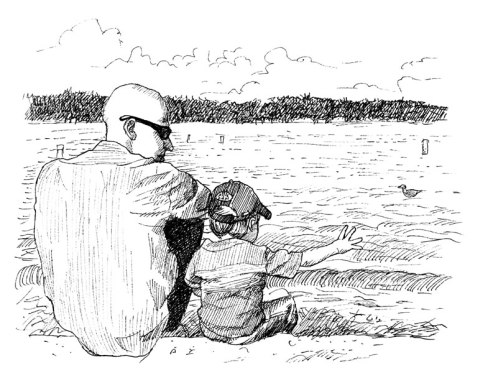
Drawings and text excerpted from the book Creation of Calm: A Cancer Survivor’s Sketchbook Story by Mark Fraley