Tag: Personal Memoirs

Grace in Horrific Times

There are 110 million displaced people in the world today, more than ever before in history.

There are more natural disasters occurring than ever before in recorded history.

There is a growing spirit of division among people, as evidenced in current discourse, events, politics and elections. So much of this division seems fueled by fear, anger, and distrust.

There have been horrific times before in history. We humans like to think we have learned from those experiences and that we wouldn’t let such things happen again. Can we learn from history? Will we? Or must history repeat itself?

Jesus said, “In this world you will have trouble. But take heart! I have overcome the world.” (John 16:33) And he said, “Peace I leave with you; my peace I give you. I do not give to you as the world gives. Do not let your hearts be troubled and do not be afraid.” (John 14:27)

Cladach has released books that feature true stories of God—and his people—at work even during the most horrific historical times. For instance:

All these personal memoirs happened in extremely tumultuous times and/or circumstances. Each describes injustices, cruelty, and evil forces unleashed on nations, people groups, and individuals. Each of these stories also gives witness to God’s personal presence, providence, and grace.

We offer these stories in the hope that readers will find renewed perspective, compassion, understanding, and hope.


Photo by theologian/photographer Thomas Jay Oord

Hope for Refugees

Lang with her brother and three sons in our backyard

On this World Refugee Day (June 20) I think of the refugees I have known. First, years ago my family helped sponsor a family of Vietnamese “boat people.” Lang, a South Vietnamese Army officer’s widow, and her brother and her three sons, escaped for their lives off the shore of Vietnam in a small boat to wander the sea along with many others. They gave everything they owned to the boat’s owner. They suffered on the sea. But they were fortunate that a ship accepted them on board and took them to a refugee camp.

Lang with my daughter

They arrived in our town frightened, slightly sick, “lost” in a completely different culture. While we waited for an apartment to open for them, this sad little family stayed in our home. Our little girl gave up her bedroom for them. Our way of living was so different from theirs. I showed them the glasses in the cupboard. They took one and drank water from it, then returned it to the cupboard. I bought five plastic glasses and wrote their names on them and lined them up on the counter for them to use.

They had experienced dangers and horrors that I could barely imagine. Even though I made beds on the floor, at night they all slept side by side on one double bed.

The word “refugees” changed in my mind from strange, almost-suspect stories into warm, real human beings.

Using gestures and a Vietnamese-English dictionary, I tried to tell Lang about Jesus’ love. Tears welled in her eyes. I tutored her in “English as a second language” for a short time. Eventually they moved to another city and I lost track of them. But I’ll never forget all I learned from them. And I have prayed that the welcome we gave them, and the bit of God’s love we tried to show them across cultural and language barriers, would grow like a seed planted—and that I will see Lang and her family again in Heaven. I look forward to worshiping around the throne the One who gave us freedom, who rescues us from sin and evil and death, and gives us the opportunity of new life and hope and peace.

Because of this experience, and then later getting to know the many Laotian refugees who came to our church, I had the opportunity to write and publish the book, No More Fear: From Killing Fields to Harvest Fields, the story of Physa Chanmany who came to America as a Cambodian refugee.

Physa also had some things in common with many refugees today. As a boy, Physa saw indescribable horror and genocide. Taught to fear Westerners, especially Americans, he had never heard the truth of Jesus. But as a lost and traumatized refugee, he had a dream in which he encountered Christ, who set his life on a new course of hope.

When a Young Father Has Cancer

“When I hear the word “cancer” … There’s deep disappointment.

“I feel I am letting my family down.

“… My body has been invaded.

“Dear God, comfort them! I can’t right now.”

“The hardest part… is not being able to pick up my son when he is close to tears.

“I love you and I know it hurts. Put your faith in me.”

During chemo … it is hard to focus on anything for more than 5 minutes.

Moments together turns into hope, a hope that is reachable and lasting.

My children provide me with strength needed to move forward. I can forget my condition when they are with me.

Cancer has a strong grip, not just on the body, but also on the mind. Even though I am now “healthy” and have not had to face it head-on in a while, it still rears its ugly head. This helps:

“So we’re not giving up. How could we! Even though on the outside it often looks like things are falling apart on us, on the inside, where God is making new life, not a day goes by without his unfolding grace.” (2 Corinthians 4:16-17 MSG)

A lot of who I am today comes from who my dad has been for years. I thank the Lord for the gift of an earthly father who just loved me!


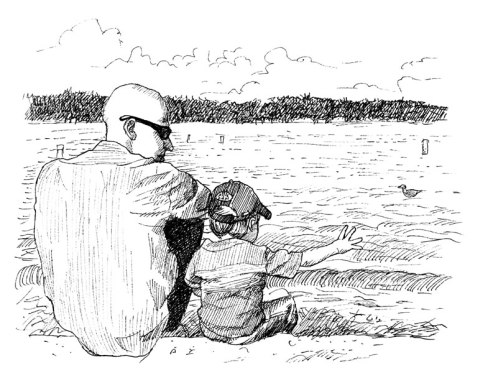
Drawings and text excerpted from the book Creation of Calm: A Cancer Survivor’s Sketchbook Story by Mark Fraley

Importance of People who Read, Review, Endorse

Book reviewers and advance readers are one important element in the publishing process. It’s hard for the author and the editors to be objective about the book they’ve been immersed in for months, maybe years. Enter readers and reviewers who usually have little or no personal stake or emotional involvement in the book. We hope they are people who appreciate good literature, who want to share God-glorifying stories with their friends, who recognize authenticity in narrative that “rings true” and offers help and hope.

We are thankful for the advance readers who, in the midst of their busy schedules, have read a pre-publication copy of On Kitten Creek: Searching for the Sacred by Nancy Swihart and have sent us these endorsement/ reviews:

Ken Canfield PhD., Founder National Center for Fathering; President, National Association for Grandparenting says:

“Nancy Swihart’s On Kitten Creek is an uplifting and thoughtful read. It’s a fresh reminder that we are each living an adventure. At times our adventurous lives, the meaning of certain events, relationships and living spaces are obscure; however when we take time and reflect, as Nancy has done, the richness in living bursts forth in her narrative like a warm sun. Reading On Kitten Creek will minister to your spirit and move you to give thanks for life’s simple gifts. I particularly enjoy the way Nancy inserts her breath of literature, practical wisdom and spiritual insights in each chapter. Her concluding and short review of the “markers” of life’s adventures is worth the price of the book alone. I know you will enjoy On Kitten Creek and hopefully it will cause you to reflect deeply about your life, as it has prompted me.”

Steven Garber, Principal of the Washington Institute for Faith, Vocation & Culture; author of Visions of Vocation: Common Grace for the Common Good says:

“’Lots of love, lots of tears, lots of growing.’ I could write on and on about the unusual richness of Nancy Swihart’s On Kitten Creek, but those few words of hers capture the life she has lived “in search of the sacred.” Always hospitable, always inviting, she is also artful and poetic, writing about her family’s life on a small farm in the Flint Hills of Kansas—the hours and days of hard work, the surprising commitment to a common life among neighbors, the celebrations and heartaches over the years. She graces us with eyes to see all of this as born of a longing for God to be present in her life and world. A quiet read for a quiet day or to be read aloud among friends, its gift is to draw us into the truest truths of the universe, sure that we have been looking over-the-shoulder and through-the-heart of someone with much to teach every one of us.”

Kay Bascom, Author, Teacher, Missionary, and Conference Speaker says:

“Strangers driving past the big red barn and outbuildings on Kitten Creek’s gravel road could never guess the magnitude of what has happened on that property in the last thirty years! The open hearts and hands there on the farm have enabled countless revolving college students and community friends to bond, build, create, study, experiment, grow, enjoy, laugh, serve, and fan out over the world, blessed. Let Nancy give you glimpses of His handiwork among us. Be inspired to look for sacred connections and creative opportunities waiting to surprise you within what may seem mundane in your own life.”

Thank you, Ken, Steven, and Kay!

May we all experience “God’s kingdom come”—more and more—on earth, and His will being done (in our lives and influence) as it is in Heaven. And may many readers be blessed by this book you have been willing to endorse with your good name.


Top photo credits: Can Stock Photo / ©Aaronam, ©monkeybusiness

If Your Animals (and Characters in Books) Could Talk

Sheep-meeting-poster

When I visited author Marilyn Wentz on her farm, I saw these sheep in a pen. The scene struck me as humorous, as if the one sheep in the foreground was holding a meeting of the flock. She seemed to have their attention. And a discussion seemed to ensue. Many of Marilyn’s (and her mother Millie’s) sheep have names. In All We Like Sheep the two shepherds tell stories of lambs and ewes named Carla, Charlene, Foxy Lady, Scotch, Squirt, Pumpkin, Spring, Teddy Bear, Gomer, Pibb, and Blue.


Better than Destruction and Despising

san-francisco-85652_1920

I’m starting a series of guest posts from authors. Today we hear from John Buzzard, whose first book, Storm Tossed, is a war memoir (of more than one kind of warfare).

As John shows here, we humans have a tendency to embrace “us and them” attitudes. We point fingers and condemn, when Jesus says to love and pray. Especially in these days of polarizing politics and issues, even Christians can find themselves in the position of using our energies protecting “our group” while, in essence, wishing that God would destroy the “other group.” John tells about a time he found himself in such a situation:


by John Buzzard:

I moved to Alameda, California, and got a job with a security company guarding the former Naval Air Station. Going from a police officer to a security guard was humbling, but I took it on faith God had something better in mind for me. My wife and the kids and I moved into a small, expensive apartment and started attending a local church.

I drove a white pickup truck around the base from 10 p.m. to 6 a.m. When I got tired I’d park on the tarmac, pour myself a cup of coffee, listen to the radio and gaze at the lights of San Francisco and the Bay Bridge. I was shocked to hear radio talkers mocking God in the name of tolerance, promoting perverted lifestyles, and encouraging hatred towards Christians.

“Oh Lord, why do You allow that wicked city to mock You and fester in sin? Why not destroy it?” I prayed.

Immediately I sensed the Holy Spirit saying to me, “Your prayer is like that of Jonah. Just like the people of Nineveh, I do not wish for these people to perish, but to repent. What if I had pronounced judgment on the world when you were still in sin? Pray for the salvation of the city, rather than its destruction.”

My attitude changed. Instead of despising many of the people of San Francisco, I felt sorry for those enslaved to the power of Satan. My prayers changed. The radio stations I listened to also changed. I found a couple of good Christian stations that provided solid teaching. At the end of my eight-hour shift I’d feel invigorated.

Over time, I also felt the Lord was telling me not to be ashamed of my own past, because there are so many people trapped by sexual sin. If they only knew my story, they could see there is hope.


This post is excerpted from the book, STORM TOSSED by Jake Porter (a pen name for author John Buzzard).

On this Holocaust Memorial Day : a Holocaust Survivor Remembers the Pet She Left Behind

Holocaust-dog

Bogar

One story in the book Faithful Friends tells about a little mixed-breed, playful dog named Bogar, loved by the Rubin family in Hungary. In 1944 “the unthinkable happened.” Cathy Rubin, a little girl at the time says, “We heard a commotion outside. On a loud-speaker the soldiers told all Jews to line up in the street. We had no place to run or hide. … We only had time to leave Bogar free outside. I prayed to God that he would be safe.”

Here is what happened as told from the dog’s point of view:

Bogar did not understand. He watched his family line up and march with everyone else. He had often gone on walks with his people; perhaps this was a walk of some kind. But he could smell the fear and sense the tension, so he knew it wasn’t a family outing like before.

When his loved ones went into the ghetto, the guards shooed him away. When he would not leave and tried to get inside to be with his family, they threw stones at him that hurt him so badly he yelped. He quickly learned not to linger near the gate. He had been left at home before, but his family had always come back, and it was rare for everyone to be gone at the same time.

So Bogar waited outside the gates of the ghetto for his family to return, being careful to stay far enough away so that no one paid much attention to him. Every now and then a soldier would toss him some scraps to eat. There was a stream nearby where he was able to drink water, and when it rained he had the puddles.

After what seemed like a lifetime, Bogar saw people coming out of the gates in a long line. He ran up and down the line until he found them, his people. Then he jumped and wiggled with joy—now they would all go home!

But they did not go home. They marched again. So, being a loyal dog, Bogar followed them.

Finally they reached the train station and he saw his family climb into a big square train car with lots of other people. There was crying. Occasionally a gun shot made him cringe; the hair rose up on his back and a deep growl rumbled in his throat.

Again, he was forced apart from his family. The soldiers shouted and shoved people. Once in a while a boot would swing in Bogar’s direction. The people getting on the train did not pay attention to him and he had to run a distance away to avoid being trampled. As he hid in some bushes, he whimpered softly, sensing that his people were going far away, leaving him for good.

Once everyone was gone, he slowly wandered around trying to figure out what had happened. He was hungry, thirsty and tired. At first he ran after the train; but he could not catch up to it. Next he went back to the ghetto, hoping that he would find his people and food there, but gone were the few soldiers who had been kind to him. He headed back to his home.

Time passed, and he found it harder to get food. There were no food scraps in the streets or garbage heaps. One time he went up to a man and the man grabbed him and hurt him. He bit the man and got away, but he instinctively knew that the man would have killed him. He became fearful of all people and avoided them, running each time someone saw him or hiding when he detected them first.

Things were not much better when he got back to his home. Some of the neighbors who were still there and knew him would leave a scrap of bone for him or some rotted food. He was not accustomed to eating vegetables but he was so hungry that he ate anything he could find. Once he even chewed the soles of a boot that he found. He went from being a clean dog with a shiny coat to a dirty, matted dog whose ribs stuck out. Even the rats, rabbits and mice became scarce. Once in a while he would catch a bird and would even eat bugs. The days wore on.

Kathy Rubin’s family survived forced labor in Austria. She writes:

On that glorious day in May, 1945, we were free! We were herded up and sent out to fend for ourselves, but we were free. We were alive and all of my family had survived. We started the long walk back to our home. It was the only place we could go.

I’ll never forget walking that final mile. Because we were all so weak, we did not talk. But in our hearts, we wondered if Bogar would be there for us….

… Every day I would walk around our community, hoping to see Bogar, praying that God would bring him home to me and my family. I asked everyone I met if they had seen him, but most people were not sure; they did not remember what he looked like. They were busy trying to survive and did not pay much attention to stray dogs. Many dogs roamed the area. Some people I asked thought Bogar was dead, others thought they saw him run away. This was understandable, since they may have seen him follow us to the ghetto and thought he was gone.

The days passed and I could not find him. I was not strong enough to walk far or I would have walked back to the ghetto and train station to look for him. Slowly my hopes diminished. We were all thankful that we made it through the war and that we were still alive. We were joyful to be reunited with some of our neighbors and friends and to be able to worship at the synagogue again. But we mourned the loss of one family member: Bogar.

We had heard stories of dogs being caught and eaten, or being beaten or shot by soldiers. The bigger dogs would attack the smaller dogs as they starved to death. It wrenched my heart to hear these stories. I kept thinking that Bogar hated the sounds of war and the soldiers so much that he would try to  escape. But how could he find food? I knew that, to survive, people had caught and eaten all the animals they could get. I wondered, What will be left for Bogar? Then I remembered that he was small and he would not need much food to live.

A month later, I was walking down the road about a mile from home, still hoping to find Bogar when I saw a dog that looked like Bogar. I thought my eyes were playing tricks on me. My heart skipped a beat and I held my breath. I hesitated to call his name, for fear it was not him and the disappointment would hurt so much.

Hesitantly, I called, “Bogar! Bogar!”

The dog stopped and looked, frozen in place. Then like a shooting star, he ran to me, jumping and licking my hands and face. It was Bogar—my sweet, wonderful Bogar!

I knelt and hugged him for a long time. What joy and relief. I thanked God for taking care of him. For the first time since we were taken away, I felt peace and hope. God did care.

The two of us hurried home as fast as our weak bodies could, and I burst through the door shouting to the family, “Bogar’s home! Bogar’s home!”
We all hugged and kissed him, then we all hugged each other, tears in everyone’s eyes. Next we gave him some of our precious little food, water and a soft, warm place to sleep. After we got over our excitement, we saw that Bogar had had a rough life while we were gone. He was thin, his coat did not shine, and it seemed that there was a haunted look in his eyes. … For the next year we had our wonderful Bogar with us, then he got sick and died and we all mourned deeply.

Kathy Rubin escaped in 1956 from Hungary. She and her husband made their way to the U.S. where they reared two children and  had many family pets. Kathy now enjoys gardening and helping people.

Read Kathy’s story and the stories of nine other Holocaust survivors in the book (from which this post is excerpted):

FAITHFUL FRIENDS : Holocaust Survivors' Stories of the Pets Who Gave Them Comfort, Suffered Alongside Them, and Waited for Their Return

FAITHFUL FRIENDS : Holocaust Survivors’ Stories of the Pets Who Gave Them Comfort, Suffered Alongside Them, and Waited for Their Return